
Cardiac rehabilitation and secondary prevention - recovery and lifestyle change after a heart event
Cardiac rehabilitation is recommended for all patients after an acute cardiac event, both in Australia and internationally. Cardiac rehabilitation aims to restore individuals to their optimal level of physical, psychological, social and vocational well-being.
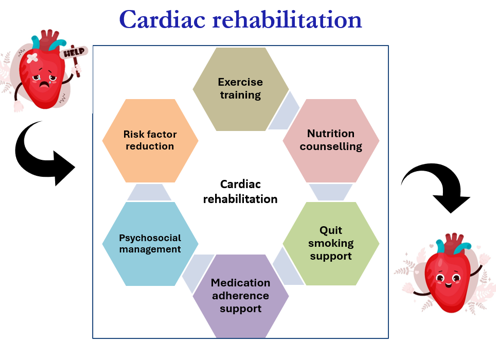
In Australia, cardiac rehabilitation is typically hospital-based, with a combination of exercise and education. The topics covered include exercise, nutrition, smoking cessation, medications, psychological recovery and risk factor reduction. Sessions are generally led by a multi-disciplinary health professional team comprising nurses, physiotherapists, exercise physiologists, dieticians, psychologists, social workers, occupational therapists pharmacists and/or physicians.
Strategies to enhance cardiac recovery
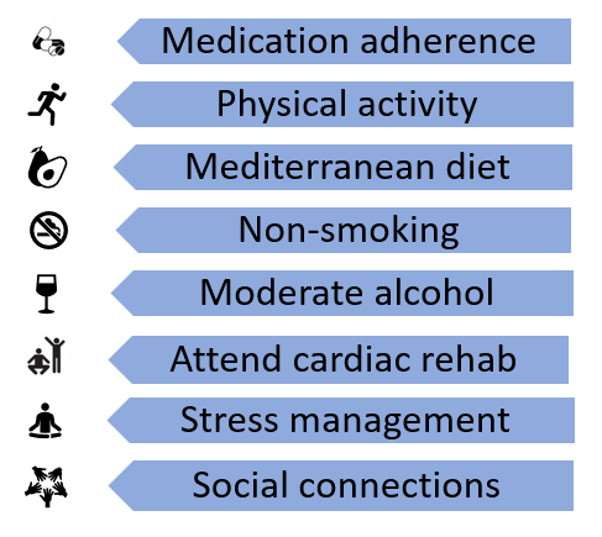
There are many changes that patients can make to their lifestyle to enhance their recovery and improve their quality of life after a heart event. This includes taking prescribed medications, increasing physical activity, sticking to a mediterranean or low salt diet, quitting smoking, attending cardiac rehabilitation, reducing life stress and increasing social connections. All these approaches improve overall wellbeing and help to reduce the risk of repeat events, re-hospitalisations, and premature mortality
Secondary prevention programs for reducing cardiac risk
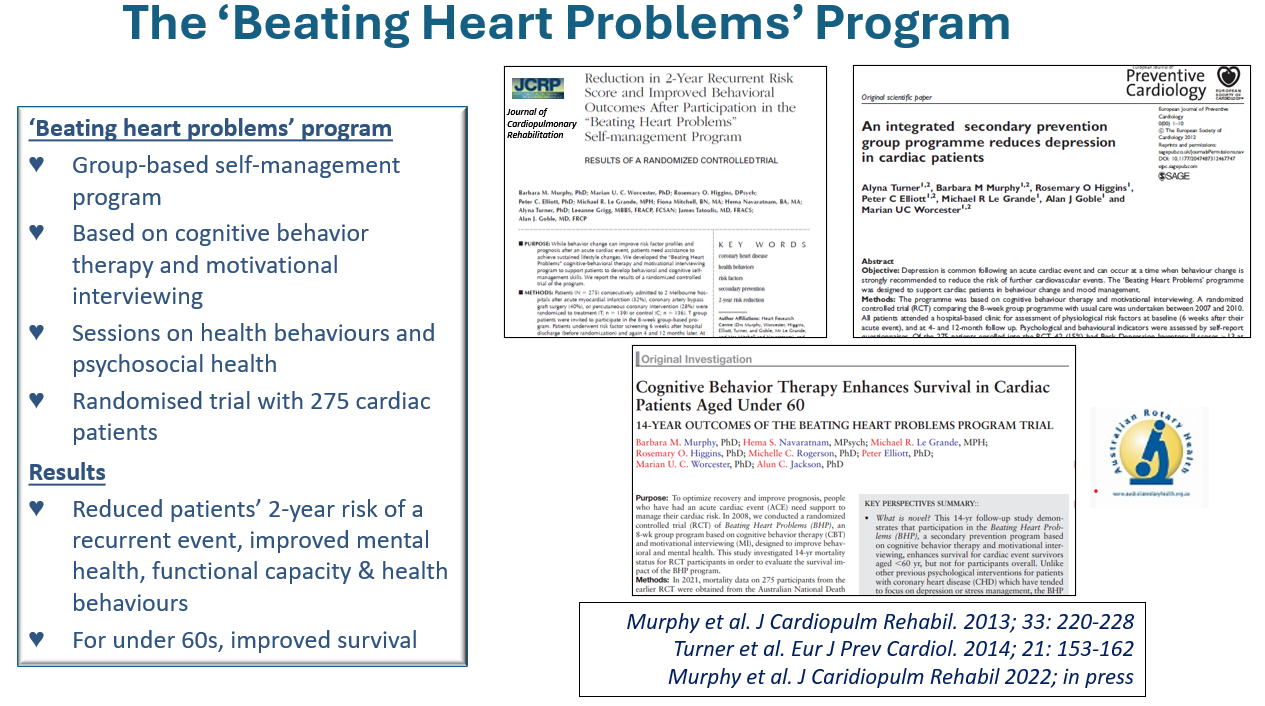
As well as attending CR, cardiac patients can also participate in secondary prevention programs to support their recovery and reduce their risk of secondary events. At the ACHH, we have developed several support programs to assist patients in their behavioural and psychosocial recovery. The ‘Beating Heart Problems (BHP) Program’ was an 8-session group-based program based on the principles of cognitive behaviour therapy (CBT) and motivational interviewing (MI). In a randomised controlled trial involving 275 cardiac patients, we demonstrated that participation in the BHP program improved behavioural and psychosocial recovery. In a 14-year follow-up we demonstrated that participants in the treatment group had reduced mortality compare to hose in the control group, highlighting the survival benefits of the program – particularly for those aged under 60 at the time of their participation.
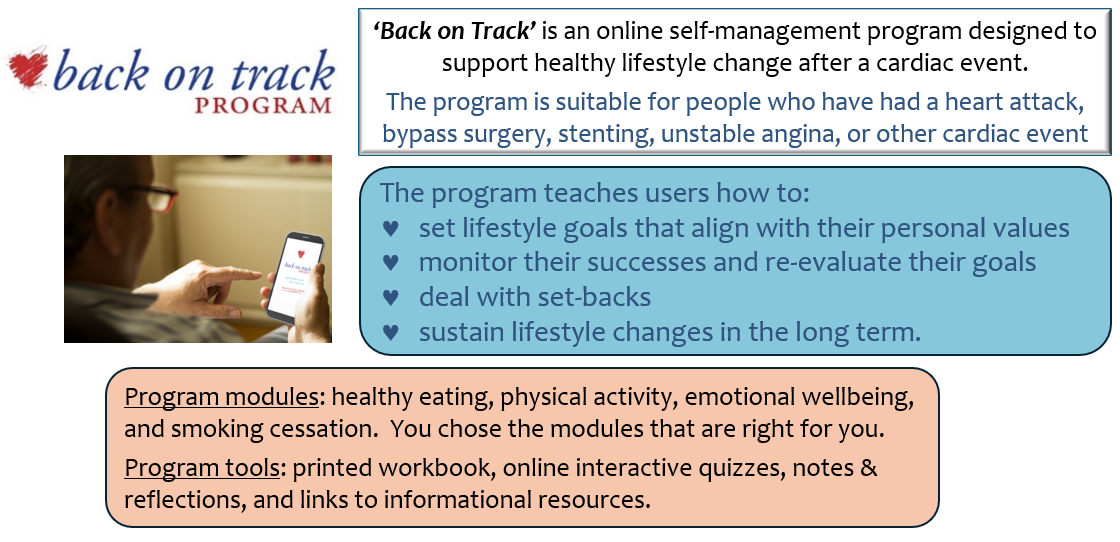
We later translated the BHP program into an online self-management program called ‘Back on Track’ and a telephone delivered program called ‘Teleheart’. Our Back on Track program has been supported by two separate grants from the HCF Research Foundation and is now delivered by HCF.
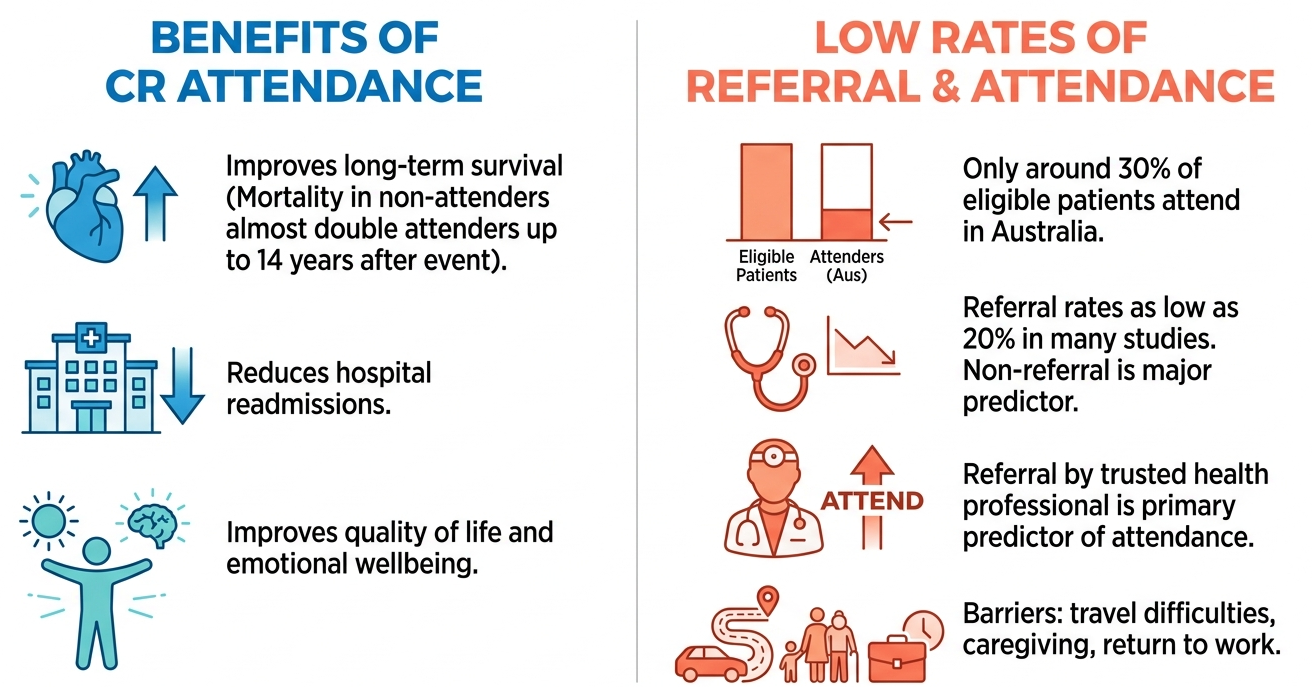
In studies conducted at the ACCH, cardiac rehabilitation attendance has been shown to improve survival, with mortality rates in non-attenders almost double those of attenders – both male and female - up to 14-years after the initial event. Cardiac rehabilitation attendance also reduces readmissions to hospital, and improves patients’ quality of life, including their emotional wellbeing.
Despite the benefits of cardiac rehabilitation, only around 30% of eligible patients attend in Australia. Attendance rates of 20-50% have been reported in studies undertaken in the US and UK. The major predictor of non-attendance is non-referral by a treating specialist, physician or other health professional, with referral rates as low as 20% in many published studies. Referral by a trusted health professional – whether that be a cardiologist, GP or other specialist - remains the primary predictor of attendance. Patient-related factors such as travel difficulties, caregiving responsibilities and return to work also act as barriers to attendance
Publications on cardiac rehabilitation, behaviour change and secondary prevention
Trevor C, Kells E, Weddell J, Murphy BM, Hesselson S, Jackson AC … Hollings M. Patient Perspectives on Cardiac Rehabilitation and Exercise After Spontaneous Coronary Artery Dissection. July 2026, Heart, Lung and Circulation, 35, 8, DOI: 10.1016/j.hlc.2026.06.022
Liao L. P, Murphy BM, Gan GCH, Thomas L, Fontana L, McKinn S, Zaman S. (2026) Determinants of Adherence to a Ketogenic Diet in Patients with Heart Failure with Reduced Ejection Fraction. Nutrients 18, 1857 DOI: 10.3390/nu18121857
Thomas EE, Le Grande MR, Jokhu LA, Goodman A, Phillips S, Smith AC, Mahoney R, Wang WYS, Oguoma VM. Participation of Aboriginal and Torres Strait Islander people in conventional cardiac rehabilitation programs: Analysis of the Queensland Cardiac Outcomes Registry. Heart, Lung and Circulation. 2025; https://doi.org/10.1016/j.hlc.2025.09.011
Thomas EE, Le Grande M, Phillips S, Cartledge S, Poulter R, Murphy BM. Predictors of Cardiac Rehabilitation Attendance and Completion: Analysis of 33,055 Patients from the Queensland Cardiac Outcomes Registry (2020 -2022). Heart, Lung and Circulation. 2025;34(1):84-94.
Rogerson MC, Jackson AC, Navaratnam HS, Le Grande MR, Higgins RO, Clarke J, Murphy BM. Behavioural and psychological telehealth support for people with cardiac conditions: Randomised trial of the ‘Back on Track’ self-management program. European Journal of Cardiovascular Nursing 2024, 23, 42-54; DOI: 10.1093/eurjcn/zvad034
Thomas E, Cartledge S, Murphy B, Abell B, Gallagher R, Astley C. et al Expanding access to telehealth in Australian cardiac rehabilitation services: A national survey. European Heart Journal – Digital Health. DOI: 10.1093/ehjdh/ztad055
Rogerson MC, Jackson AC, Navaratnam HS, Le Grande MR, Higgins RO, Clarke J, Murphy BM. Behavioural and psychological telehealth support for people with cardiac conditions: Randomised trial of the ‘Back on Track’ self-management program, European Journal of Cardiovascular Nursing, March 2023, DOI: 10.1093/eurjcn/zvad034
Cartledge S, Thomas EE, Murphy BM, Abell B, Verdicchio C, Zecchin R, Cameron J, Gallagher R, Astley C. on behalf of ACRA COVID working group. Impact of early COVID-19 waves on cardiac rehabilitation delivery in Australia: A national survey. Heart, Lung and Circulation 2023; 32(3): 353–363.
Murphy BM, Navaratnam HS, Le Grande MR, Higgins RO, Rogerson MC, Elliott P, Worcester MUC, Jackson AC. Cognitive Behaviour Therapy enhances survival in cardiac patients aged under 60: 14-year outcomes of the Beating Heart Problems program trial. Journal of Cardiopulmonary Rehabilitation, 43, 3, 170-178, DOI: 10.1097/HCR.0000000000000753
Ghorbani B, Mahdegar M, Jackson AC…Bahramnezhad F. Comparison of the effects of Gamification and Teach Back training methods on adherence to treatment regimen of patients after coronary artery bypass graft surgery: A randomized control trial. Journal of Medical Internet Research, 23(12) 2021:e22557 DOI: 10.2196/22557
Cartledge S, Rawstorn JC, Tran M, Ryan P, Howden EJ, Jackson AC. Telehealth is here to stay but not without challenges: A consultation of cardiac rehabilitation clinicians during COVID-19 in Victoria, Australia, European Journal of Cardiovascular Nursing https://doi.org/10.1093/eurjcn/zvab118
Rogerson MC, Jackson AC, Navaratnam HS, Le Grande MR, Higgins RO, Clarke J, Murphy BM Getting ‘Back on Track’ after a cardiac event: Protocol for a Randomised Controlled Trial of an online self-management program. JMIR Research Protocols. 15/11/2021:34534
Bahramnezhad F, Sanaie N, Jackson AC, Shariati E, Atashzadeh-Shoorideh F. The effect of partnership-based education on adherence to the treatment plans in open heart surgery. Journal of Education and Health Promotion 2021; 10:353.
Asgari P, Jackson AC, Esmaeili M, Bahramnezhad F. Nurses' experience of patient care utilizing extracorporeal membrane oxygenation, Nursing in Critical Care DOI:1111/nicc.12684
Cartledge S, Gallagher C, Rawstorn J, Thomas E, Bourne C, Janssen K, Macauley L, Sanderson S, Jackson AC, Hendriks J. It’s easier than you think to make a conference virtual – learning from our pandemic experience. European Journal of Cardiovascular Nursing, doi:10.1093/eurjcn/zvab044
Murphy BM, Kuhn L, Cameron J. Understanding the differences between men and women: reflections on recent studies in cardiovascular care. European Journal of Cardiovascular Nursing 2021; doi.org/10.1093/eurjcn/zvab095
Thayabaranathan T, Cameron J, Murphy BM, Cadilhac D. Yoga: a potential adjunct therapy to current rehabilitation pathways in cardiac conditions and stroke. OBM Geriatrics. 2021 5(1): doi:10.21926/obm.geriatr.2101155
Murphy B, Zaman S, Tucker K, Alvarenga M, Morrison-Jack J, Higgins R, Le Grande M, Nasis A, Jackson AC. Enhancing the appeal of cardiac rehabilitation for women: development and pilot testing of a women-only yoga CR program. European Journal of Cardiovascular Nursing doi:10.1093/eurjcn/zvab008
Beauchamp A, Sheppard R, Wise F, Jackson AC. Health Literacy of Patients Attending Cardiac Rehabilitation, Journal of Cardiopulmonary Rehabilitation and Prevention: July 2020, 40, 4: 249-254 doi: 10.1097/HCR.0000000000000473
Cameron J, Murphy B, Kuhn L. Improving the uptake of cardiac rehabilitation for women: time for a gender-based review. European Journal of Cardiovascular Nursing 2019:18(5):344-45.
Shand L, Higgins RO, Murphy BM, Jackson AC. Development and validation of the Healthcare Provider Patient-Activation Scale, Patient Education and Counseling, 2019, https://doi.org/10.1016/j.pec.2019.03.005
Murphy, BM, Higgins, RO Le Grande, MR, Beauchamp A, Worcester, MU, Goble A, Jackson AC. Impact of intensive training on health professionals’ self-efficacy in establishing, running and maintaining a cardiac rehabilitation program, Journal of Nursing Education and Practice, 2019, 9,7, 1-9
Jackson AC, Higgins RO, Murphy BM, Rogerson M, Le Grande M, Cardiac rehabilitation in Australia: A brief survey of program characteristics, Heart, Lung & Circulation, Online October 2017, https://doi.org/10.1016/j.hlc.2017.08.024
Higgins R.O, Rogerson M, Murphy, B.M, Navaratnam H, Butler M.V., Barker L, Turner A, Lefkovits J, Jackson AC. (2017) Cardiac rehabilitation online pilot: extending reach of cardiac rehabilitation. Jnl Cardiovascular Nursing, 32, (1): 7-13
Higgins RO, Murphy BM, Navaratnam H, Jackson AC. Extending cardiac rehabilitation: a telephone self-regulation pilot, British Journal of Cardiac Nursing, 2017, 12,8, 398-406
Murphy BM. Stress management training should be an integral component of cardiac rehabilitation. BMJ Evidence Based Medicine 2017 Online first: 10.1136/ebmed-2016-110532
Ski CF, van der Wal MHL, Le Grande M, van Veldhuisen DJ, Lesman-Leegte I, Thompson DR, Middleton S, Cameron J, Jaarsma T: Patients with heart failure with and without a history of stroke in the Netherlands: a secondary analysis of psychosocial, behavioural and clinical outcomes up to three years from the COACH trial. BMJ Open 2019, 9(8):e025525.
Jackson AC, Le Grande M, Higgins RO, Rogerson M, Murphy BM (April 2016). Psychosocial screening and assessment practice within cardiac rehabilitation: A survey of cardiac rehabilitation coordinators in Australia, Heart, Lung and Circulation, Online first, DOI: http://dx.doi.org/10.1016/j.hlc.2016.04.018
Rogerson M, Le Grande M, Dunstan D, Murphy BM, Salmon J, Gardiner P, Jackson AC (2016). Television viewing time and 13-year mortality in adults with cardiovascular disease: Data from the Australian Diabetes, Obesity and Lifestyle Study (AusDiab), Heart, Lung & Circulation, 25, 8, 829-836, do:10.1016/j.hlc.2016.03.006
Rogerson M C, Le Grande MR, Murphy BM, Neubeck L, Jackson AC (2016). Screening for sedentary behaviour in cardiac rehab, British Jnl of Cardiac Nursing, 11, 4, 198–199 DOI: 10.12968/bjca.2016.11.4.198
Le Grande M, Murphy B, Rogerson M, Elliott P, Worcester M. Determinants of physical activity guideline attainment in cardiac patients: A 12-month longitudinal study. Journal of Cardiopulmonary Rehabilitation and Prevention 2015; 35(6):399-408. doi: 10.1097/HCR.0000000000000137
Higgins, R.O., Rogerson, M., Murphy, B.M., Navaratnam, H., Butler, M., Barker, L., Turner, A., Lefkowitz, J., Jackson AC. (2015). Cardiac rehabilitation online pilot: Extending reach of cardiac rehabilitation. The Journal of Cardiovascular Nursing, Online October; DOI: 10.1097/JCN.0000000000000297
Worcester M, Elliott P, Turner A, Pereira J, Murphy B, Le Grande M, Middleton K, Navaratnam H, Nguyen J, Newman R, Tatoulis J. Resumption of work after acute coronary syndrome or coronary artery bypass graft surgery. Heart Lung & Circulation 2014;23:444-453
Turner A, Murphy B, Higgins R, Elliott P, Le Grande M, Goble A, Worcester M. An integrated secondary prevention group program reduces depression in cardiac patients. Eur J Prev Cardiol 2014; 21(2): 153-162. doi:10.1177/2047487312467747
Higgins RO, Le Grande MR: Postangiography patients who complete cardiac rehabilitation have reduced risk of mortality or hospitalisation compared to non-completers. Evid Based Nurs 2013, 16(3):82-83.
Murphy B, Worcester M, Higgins R, Elliott P, Navaratnam H, Mitchell F, Grigg L, Tatoulis J, Goble A. Reduction in two-year recurrent risk score and improved behavioural outcomes after participation in the Beating Heart Problems self-management program: results of a randomised controlled trial. Journal of Cardiopulmonary Rehabilitation. 2013;33: 220-28.
Rogerson M, Murphy B, Le Grande M, Worcester, M. Physical inactivity at leisure and work: A 12-month study of cardiac patients. Journal of Cardiopulmonary Rehabilitation and Prevention 2013;33(6):385-395.
Beauchamp A, Worcester M, Ng A, Murphy B, Tatoulis J, Grigg L, Newman R, Goble A. Attendance at cardiac rehabilitation is associated with lower all-cause mortality after 14 years of follow-up. Heart 2013;99:620-25. doi:10.1136/heartjnl-2012-303022
Beauchamp A, Worcester M, Tatoulis J, Murphy B, Ng A. Cardiac rehabilitation mortality trends: how far from a true picture are we? Heart 2013;99:968-68.
Higgins R, Navaratnam H, Murphy B, Walker S, Worcester M. Outcomes of a chronic heart failure training program for health professionals. J Nursing Educ Prac 2013;3:68-74. doi:10.5430/jnep.v3n7p68.
Rogerson M, Murphy B, Bird S, Morris T. “I don’t have the heart”: A qualitative study of barriers to and facilitators of physical activity for people with coronary heart disease and depressive symptoms. International Journal of Behavioural Nutrition and Physical Activity 2012;9:140. http://www.ijbnpa.org/content/9/1/140
Higgins R, Murphy BM, Worcester MU, Daffey A. Supporting chronic disease self-management: translating policies and principles into clinical practice. Aust J Prim Health 2012; 18(1); 80-8. http://dx.doi.org/10.1071/PY11006.
Elliott PC, Smith G, Ernest CS, Murphy BM, Worcester MUC, Higgins RO, Le Grande MR, Goble AJ, Andrewes D, Tatoulis J. Everyday cognitive functioning in cardiac patients: Relationships between self-report, report of a significant other and cognitive test performance. Aging Neuropsychology and Cognition 2010;17:71-88
Higgins R, Murphy B, Goble A, Le Grande M, Elliott P, Worcester M. Cardiac rehabilitation program attendance after coronary artery bypass graft surgery – overcoming the barriers. Medical Journal of Australia 2008;188:712-14.
Le Grande MR, Elliott PC, Worcester MU, Murphy BM, Goble AJ. An evaluation of self-reported physical activity instruments suitable for use in studies involving cardiac patients. Journal of Cardiopulmonary Rehabilitation and Prevention 2008;28(6):358-369.
Rushford N, Murphy B, Worcester M, Goble A, Higgins R, Le Grande M, Rada J. Adequacy of information received in hospital by female cardiac patients. European Journal of Cardiovascular Prevention and Rehabilitation 2007;14:463-469.
Ernest CS, Elliott P, Murphy BM, Worcester MUC, Higgins RO, Goble AJG, Le Grande MR, Tatoulis J. Predictors of cognitive function in candidates for coronary artery bypass graft surgery. Journal of the International Neuropsychological Society 2007;13:257-266.
Ernest CS, Murphy BM, Worcester MUC, Higgins RO, Elliott PC, Goble AJ, Le Grande MR, Tatoulis J. Cognitive function in candidates for coronary artery bypass graft surgery. Annals of Thoracic Surgery 2006;82:812-8
Murphy BM, Worcester MUC, Elliott PC, Le Grande MR, Higgins RO, Goble AJ. Change in women’s dietary fat intake following an acute cardiac event: extent, predictors and comparison with non-cardiac Australian adults. European Journal Cardiovascular Nursing 2006;5:206-213.
Ernest CS, Worcester MUC, Tatoulis J, Elliott PC, Murphy BM, Higgins RO, Le Grande MR, Goble AJ. Neurocognitive outcomes in off pump vs. on pump bypass surgery: a prospective randomized controlled trial. Annals of Thoracic Surgery 2006;81:2105-14.
51. Le Grande M, Murphy B, Higgins R, Worcester M, Parkinson A, Brown S, Elliott P, Goble A. Physical activity and negative emotional response following percutaneous coronary intervention. European Journal of Cardiovascular Prevention and Rehabilitation 2006;13:254-260.
Murphy B, Worcester MUC, Higgins R, Le Grande M, Larritt P, Goble AJG. Causal attributions for heart disease among female cardiac patients. Journal of Cardiopulmonary Rehabilitation 2005;25(3):135-143.
Higgins RO, Murphy BM, Le Grande MR, Parkinson A, Worcester MUC, Goble AJ. Expressed preferences for health education of patients after percutaneous coronary intervention. European Journal of Cardiovascular Prevention and Rehabilitation 2005; 12: 572-79.
Worcester MUC, Murphy BM, Mee VK, Roberts SB, Goble AJ. Cardiac rehabilitation programs: predictors of non-attendance and drop-out. European Journal of Cardiovascular Prevention and Rehabilitation 2004;11(4): 328-335.
Worcester MUC, Stojcevski Z, Murphy B, Goble AJ. Long-term behavioural outcomes following attendance at a secondary prevention clinic for cardiac patients. Journal of Cardiopulmonary Rehabilitation 2003;23:415-422.
Worcester MUC, Stojcevski Z, Murphy B, Goble AJ. Factors associated with non-attendance at a secondary prevention clinic for cardiac patients. European Journal of Cardiovascular Nursing 2003;2:151-157.
Goble A, Jackson B, Phillips P, Race E, Oliver RG, Worcester MC. The Family Atherosclerosis Risk Intervention Study (FARIS): risk factor profiles of patients and their relatives following an acute cardiac event. Aust N Z J Med. 1997 Oct;27(5):568-77.
Worcester, M. C., et al. (1993). Early programmes of high and low intensity exercise and quality of life after acute myocardial infarction. BMJ 1993; 307(6914): 1244–1247.
Goble AJ, Worcester MC. Maintenance of behaviour change in patients with coronary artery disease. Ann Acad Med Singap. 1992 Jan;21(1):97-100.
Goble AJ, Hare DL, Macdonald PS, Oliver RG, Reid MA, Worcester MC. Effect of early programmes of high and low intensity exercise on physical performance after transmural acute myocardial infarction. Br Heart J. 1991 Mar;65(3):126-31.