Recovery after SCAD
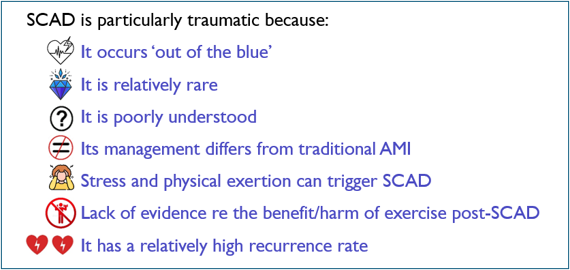
Spontaneous coronary artery dissection (SCAD) is an increasingly recognised cause of heart attack that occurs due to a tear in a coronary artery. SCAD heart attack is particularly stressful due to its unexpected occurrence in adults under 50, particularly women, with few traditional cardiovascular risk factors. The lack of clear management guidelines contribute to fear, confusion, distress and anxiety.
Our SCAD Studies
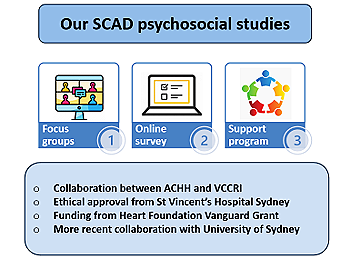
Research into the psychosocial impacts of SCAD has gained increased research interest in recent years and the ACHH has been at the forefront of this research.
We have undertaken several studies to investigate the psychological and lifestyle impacts of SCAD, and to identify ways to support SCAD survivors in their recovery.
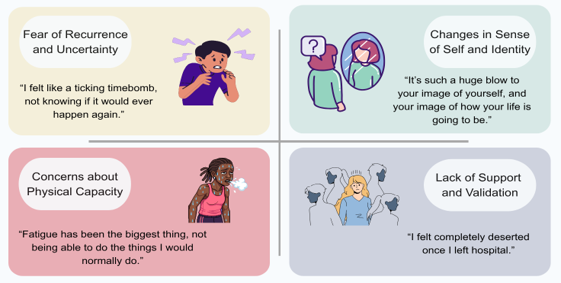
What is SCAD Distress?
There are four key domains of SCAD-related distress:
We have developed the 33-item SCAD Distress Inventory to assess these four domains of SCAD-related distress.
Investigators and Research Partners
Australian Centre for Heart Health & University of Melbourne: A/Prof Barbara Murphy, Dr Michael Le Grande, Dr Sarah Clarke, Dr Michelle Rogerson, Prof Alun Jackson. Victor Chang Cardiac Research Institute: Prof Bob Graham, Prof Jason Kovacic, Dr Stephanie Hesselson, Dr Siiri Iismaa. SCAD Research Australia: Sarah Ford. Lived experience SCAD survivors: Jodi Brown, Alex Wynd, Dr Donita Baird, Trudi Musgrave-Edwards. University of Sydney & Westmead Hospital: Prof Sarah Zaman, Dr Quan Dang, Dr Joseph Weddell, Dr Matthew Hollings, Chloe Trevor, Libby Kells, Prof Robyn Gallagher.

Pictured: Dr Michelle Rogerson, Dr Siiri Iisma, A/Prof Barbara Murphy, Dr Stephanie Hesselson (seated), A/Prof Alun Jackson, Ms Jodi Brown, Prof Robert Graham.
Publications
Murphy BM, Le Grande MR, Clarke ST, Hesselson S, Iismaa SE, Rogerson MC, Ford S, Kovacic J, Graham RM, Jackson AC. Development and validation of a measure of psychological distress after spontaneous coronary artery dissection: The Spontaneous Coronary Artery Dissection Distress Inventory (SDI). Journal of the American Heart Association. 2026;15(6):e047498.
Clarke ST, Murphy BM, Le Grande MR, Rogerson MC, Kovacic JC, Hesselson S, Iismaa SE, Graham RM, Jackson AC. The impact of fear of recurrence and progression on mental health after spontaneous coronary artery dissection: the role of illness uncertainty. Eur J Cardiovasc Nurs. 2026. Mar 25:zvag090. doi: 10.1093/eurjcn/zvag090. Epub ahead of print. PMID: 41878776.
Murphy BM, Rogerson MC, Iismaa SE, Hesselson S, Le Grande MR, Graham RM, Jackson AC. Attitudes to and attendance at cardiac rehabilitation after spontaneous coronary artery dissection. J Cardiopulm Rehabil Prev. 2025;45(3):181-91.
Rogerson MC, Le Grande M, Higgins R, Hesselson S, Iismaa SE, Graham RM, Jackson AC, Murphy BM, et al. Supporting emotional recovery after spontaneous coronary artery dissection: Development and pilot-testing an online facilitated support group program. Journal of Clinical Psychology in Medical Settings. 2025; DOI: 10.1007/s10880-025-10083-3
Rogerson MC, Jackson AC, Le Grande MR, Hesselson S, Iismaa SE, Graham RM, Murphy BM. Posttraumatic Growth after Spontaneous Coronary Artery Dissection: A Mixed-Methods Study. Heart and Mind. 2024;8(4):325-39. DOI: 10.4103/hm.HM-D-24-00022.
Murphy BM, Le Grande MR, Rogerson MC, Hesselson S, Iismaa SE, Graham RM, Jackson AC. Prevalence and correlates of anxiety and depressive symptoms after Spontaneous Coronary Artery Dissection (SCAD): a cross-sectional study, European Journal of Cardiovascular Nursing, 2024; zvae071, https://doi.org/10.1093/eurjcn/zvae071
Murphy BM, Rogerson MC, Le Grande MR, Hesselson S, Iismaa SE, Graham RM, Jackson AC,. Psychosocial and lifestyle impacts of spontaneous coronary artery dissection: A quantitative study. PLoS One. 2024;19(1):e0296224.
Weddell J, Rogerson MC, Gallagher R, Hesselson S, Iismaa S, Graham RM, Jackson AC, Redfern J, Buckley T, Murphy B. Cognitive and physical fatigue-the experience and consequences of 'brain fog' after spontaneous coronary artery dissection: a qualitative study. Eur J Cardiovasc Nurs. 2024;23(8):855-62.
Dang QM, Murphy B, Ford S, Graham R, Zaman S. Patients’ perspective of quality-of-care and its correlation to quality-of-life following spontaneous coronary artery dissection. Eur J Cardiovasc Nurs. 2024;23(4):400-7. doi: 10.1093/eurjcn/zvad096.
Rogerson M, Hesselson S, Iismaa S, Higgins R, Le Grande M, Graham R, Jackson A, Murphy B. Addressing the urgent need for psychosocial support for SCAD survivors though collaborative research and program development, INSPIRE 2023; 029: 12-13. https://issuu.com/researchaustralia/docs/ra0077_inspire_sept23_?fr=xKAE9_zU1NQ
Murphy BM, Rogerson MC, Hesselson S, Iismaa S, Graham R, Jackson AC. Psychosocial Impacts of Spontaneous Coronary Artery Dissection: A qualitative study, PLoS ONE 2022; 17(9): e0273978. doi.org/10.1371/journal.pone.0273978
Murphy BM, Graham RM, Rogerson MC, Hesselson S, Iismaa SE, Hoover V, Le Grande MR, Jackson AC. SCAD: a challenging and under-recognised form of heart attack, MJA Insighthttps://insightplus.mja.com.au/2022/40/scad-challenging-under-recognised-form-of-heart-attack/
Find out more about SCAD at www.scadresearch.com.au