
Enhancing self-management in young people with congenital heart disease transitioning from paediatric to adult care: An AI-powered graphic medicine approach
The aim of this project is to develop a graphic medicine resource suite (a graphic novel, Heartsore; an AI-powered companion, and educational resources relevant to both young people and parents) and conduct a feasibility study at the Royal Children's Hospital (RCH) to evaluate its acceptability and preliminary effectiveness for young people managed through the RCH's world-renowned paediatric to adult care transition process.
We also want to know how useful this resource is for young people with other conditions such as diabetes, cystic fibrosis and kidney disease.
The findings from this two-group, pre–post design study will inform the design and powering of a subsequent multi-site definitive trial.
Why effective engagement of young people in this process is vital
Up to 60% of young people disengage from medical follow-up following paediatric to adult care transition, often due to low health literacy; being emotionally overwhelmed; struggling with autonomy and responsibility; competing priorities (including school, identity, relationships); stigma, and denial; and difficulty navigating complex health systems. This disengagement severely compromises health and can lead to premature death.
This is an area that we have been concerned about for some time.
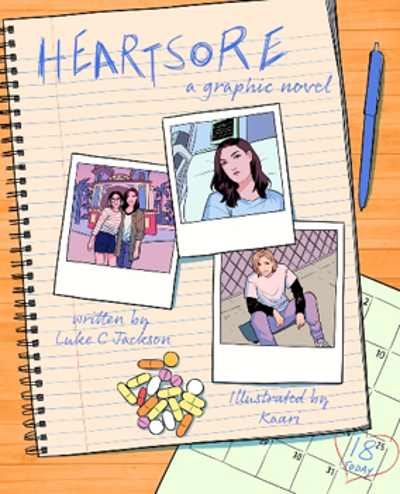
What is the graphic novel about?
This coming-of-age graphic novel follows Tara, a young woman in her final year of high school who has never allowed herself to imagine a life beyond what she has always known. When she meets the free-spirited Elodie, Tara starts to test the boundaries between who she has been and who she might become.
Tara had her first heart surgery when she was only a few days old. Over the next fifteen years, she underwent two more operations. Each one kept her alive but required weeks of recovery and added to a growing list of medications she must take to manage her condition. As she approaches her eighteenth birthday, she is filled with both excitement and trepidation.
Having grown up in a system where every decision about her life has been made for her by doctors, parents, and circumstance, Tara must now transition from paediatric to adult healthcare. As she begins making her own decisions, the tension between managing her condition and managing her identity intensifies, worrying those who care about her most.
Heartsore is an unflinching exploration of identity, friendship, and independence. It reveals the pressures that shape life for young people living with a chronic condition when they reach an age where more is expected of them than ever before.
What would the AI companion do?
An AI conversational companion is a new application of Large Language Model technology in adolescent health education. Unlike digital health tools that rely on fixed question sets or branching decision trees, the companion will enable young people to articulate their thoughts, fears, and questions in their own words.
The system will respond through guided prompts that deepen reflection and extend understanding. In this way the AI conversational companion will function as an experiential mediator making learning feel personal, supported, and low-pressure.
No comparable resource currently exists that combines narrative-based graphic medicine with responsive AI companionship.
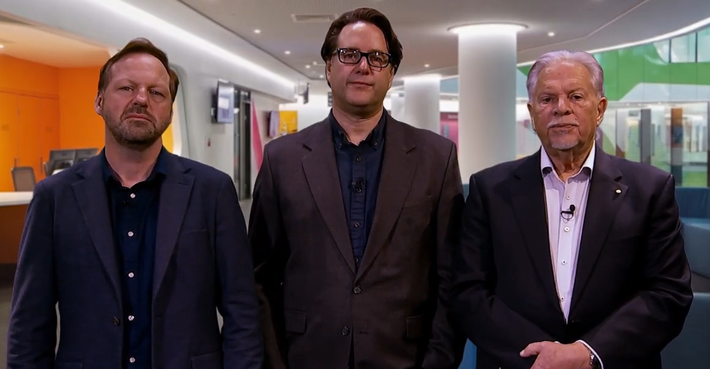
See Professor Alun Jackson from ACHH, Professor Stefan Greuter from the RMIT University Centre for Digital Ecosystems, and Dr Luke Jackson from Narrative Immersion, discuss the project on the following YouTube video: https://www.youtube.com/watch?v=v4vMtHL7ha8
Publications from our congenital heart disease program
Jackson AC., Frydenberg, E., Liang, R. P-T., Higgins, R.O., Murphy, B.M. (2015). Familial coping with child heart disease: A systematic review. Pediatric Cardiology, 36,4, 695-712. DOI: 10.1007/s00246-015-1121-9
Jackson AC, Frydenberg E, Liang R P-T, Higgins RO, Murphy BM (2016). Parental coping programs for special needs children: A systematic review, Journal of Clinical Nursing, 25, 1528–1547, doi: 10.1111/jocn.13178
Jackson AC., Higgins, R.O, Frydenberg, E., Liang, R., Murphy, B.M. (2018). Parent's Perspectives on How They Cope with the Impact on Their Family of a Child with Heart Disease, Journal of Pediatric Nursing, https://doi.org/10.1016/j.pedn.2018.01.020
Jackson AC., Frydenberg E., Koey XM, Fernandez A, Higgins RO, Stanley T., Pui-Tak Liang R., LeGrande MR, Murphy, BM. Enhancing parental coping with a child’s heart condition: A co-production pilot study, Comprehensive Child and Adolescent Nursing, https://doi.org/10.1080/24694193.2019.1671915
Jackson AC. (2020). Managing Uncertainty in Prenatal Diagnosis of Congenital Heart Disease. JAMA Network Open, 3(5), e204353-e204353. doi:10.1001/jamanetworkopen.2020.4353
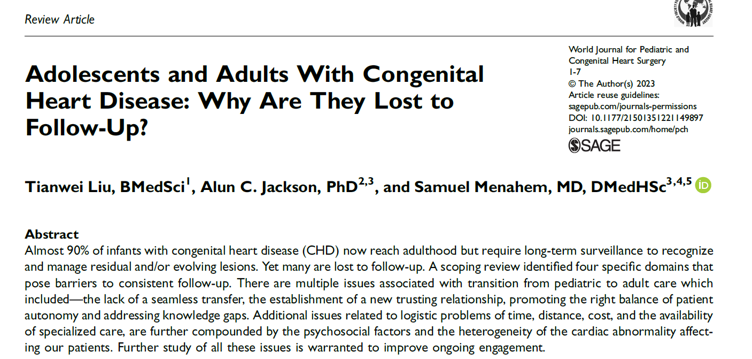
Liu T, Jackson AC, Menahem S. Adolescents and Adults with Congenital Heart Disease - Why are they lost to follow-up? World Journal for Pediatric and Congenital Heart Surgery, 2023: 21501351221149897. DOI: 10.1177/21501351221149897